

Start Slugging Safely: 1–3 Nights a Week for Dry, Dehydrated Skin
Yes, slugging works for many people with dry or dehydrated skin. Sealing in moisture with a thin occlusive layer can meaningfully cut water loss and support barrier repair when you do it correctly. Start by slugging a few nights per week, increasing frequency to nightly only if you have severe dryness or are exposed to cold weather. If you’re oily or acne-prone, proceed carefully or skip it altogether.
TL;DR:
- Slugging primarily seals in existing moisture and active ingredients, aiding barrier repair and reducing transepidermal water loss in dry skin.
- It is most effective when layered over hydrating serums and moisturizers designed to support barrier function, applied on nearly dry skin.
- Those with oily, acne-prone, or fungal-affected skin should be cautious or avoid full-face slugging to prevent clogged pores or yeast growth.
- Starting with one to three nights weekly and avoiding actives under occlusion can prevent irritation and unwanted breakouts.
- Persistent irritation, breakouts, or worsening skin conditions after slugging should prompt consulting a dermatologist.
Table of Contents
- What Is Slugging for Dry Skin, Exactly?
- What Are the Real Benefits of Slugging?
- Who Should Try Slugging, and Who Should Skip It?
- How to Slug Your Face Step by Step
- Petroleum Jelly, Aquaphor, or a Healing Ointment: Which Occlusive?
- When Should You See a Dermatologist About Slugging?
- Where Slugging Fits Into a Real Skincare Routine
- An Editorial Take: Slugging Is a Tool, Not a Lifestyle
- Give Your Skin Something Worth Sealing In
- Sources
- FAQ
What Is Slugging for Dry Skin, Exactly?
Slugging gets its name from the shiny, slug-like finish an occlusive leaves on your face, and it’s really just a fancy label for something dermatology has recommended for decades: coating skin in petroleum jelly overnight. The technique blew up on social media, but the science behind it is old news to anyone who has treated eczema.
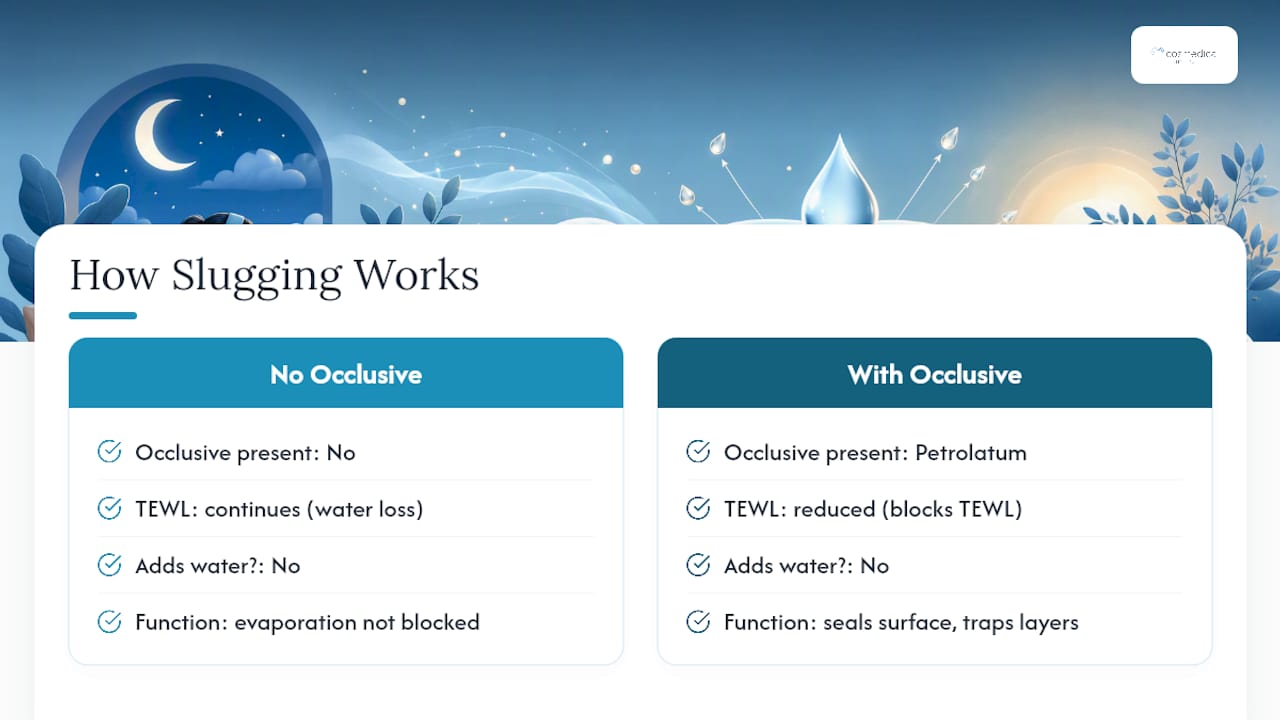
Here’s the mechanism, in plain terms: your skin loses water constantly through evaporation, a process called transepidermal water loss, or TEWL. An occlusive like petrolatum sits on top of skin and physically blocks that evaporation, and clinical summaries show petrolatum significantly reduces TEWL, which is why it shows up in barrier-repair treatments for eczema-prone skin.
That’s the part people misunderstand most. Slugging doesn’t hydrate your skin. It doesn’t add a drop of water. Think of it as a lid on a pot, not the water in it. Whatever moisture and active ingredients you applied underneath, the occlusive traps them against your skin instead of letting them evaporate into the room. Skip the layers underneath and you’re just sealing in dry skin.
What Are the Real Benefits of Slugging?
For dry, flaky, or barrier-compromised skin, the payoff is real and fairly quick. Slugging works by trapping whatever hydration is already on your skin, so the benefits show up wherever moisture retention is the missing piece.
- Reduced water loss overnight, which keeps skin from waking up tighter and flakier than it went to bed
- Faster recovery after irritation, including redness or peeling from a new retinoid or an aggressive exfoliating acid
- Softer texture by morning, an effect most people notice the very first time they try it
- Support for barrier repair over time, since a stable moisture environment gives compromised skin room to rebuild
The timeline matters here. That next-morning softness is immediate, but the structural improvement, such as a repaired barrier and less chronic flaking, generally takes several weeks of consistent use. Slugging once and expecting your barrier to be fixed by Tuesday is like expecting one good night of sleep to undo a month of exhaustion. It helps, but repair takes repetition.
Who Should Try Slugging, and Who Should Skip It?
Slugging isn’t universal, and pretending otherwise is how people end up with clogged pores instead of glowing skin. Dermatologists note that petrolatum, while non-comedogenic itself, can still trap oil and bacteria against the skin in people who are prone to breakouts.
Good candidates:
- People with genuinely dry or dehydrated skin, especially in winter
- Eczema-prone or barrier-compromised skin
- Mature skin that struggles to hold onto moisture
- Post-procedure skin healing after peels, microneedling, or laser treatments
Proceed with caution or skip:
- Oily or acne-prone skin, where trapped sebum can trigger breakouts
- Anyone dealing with fungal acne, since occlusives can feed the yeast that causes it
- Active cystic acne or open lesions
If you’re combination or slightly oily but still curious, spot-slugging is your answer: apply the occlusive only to genuinely dry patches (cheeks, around the mouth, flaky eyebrow edges) instead of the whole face. And if you’re reaching for a healing ointment rather than pure petroleum jelly, check the label for lanolin. Lanolin allergy is common enough that it deserves a patch test before you slather it across your face.
How to Slug Your Face Step by Step
Getting the order right is what separates “glowing” from “greasy and clogged.” Here’s the routine that actually works.
Start by cleansing your face and pat it mostly, but not completely, dry. Leaving a little dampness helps your next layers absorb better. Skip slugging entirely if you still have heavy sunscreen, makeup, or SPF residue on your skin. Sealing that in with an occlusive is a fast track to a breakout.
- Cleanse with a gentle, non-stripping cleanser and pat skin nearly dry.
- Apply a hydrating serum with humectants like hyaluronic acid while skin is still slightly damp, so it has water to hold onto.
- Layer a moisturizer with ceramides or ceramide-adjacent ingredients to reinforce the barrier underneath.
- Apply the occlusive last, using a pea-sized amount for your whole face. Consumer-facing dermatology coverage is consistent on this point: less is more, and a thin layer works better than a thick one.
- Respond to how skin responds, starting at one to three nights a week and scaling to nightly only if dryness is severe.
Skip actives on slugging nights. Retinoids, retinol, and exfoliating acids sealed under an occlusive can intensify irritation instead of just working faster, so treat those as separate nights.
Pro Tip: If your slug layer feels greasy or “pills” when you touch it, you’ve applied too much. Rub the excess between your palms first, then press what’s left onto your face instead of scooping straight from the jar.

Pillow transfer is the most common complaint. An old pillowcase or a silk one that wipes clean easily solves it without you having to change your routine. If you notice new bumps or clogged pores after a few nights, that’s your skin telling you to scale back or switch to spot-slugging instead of full coverage.

Petroleum Jelly, Aquaphor, or a Healing Ointment: Which Occlusive?
Not every occlusive is the same product wearing a different label, and the differences actually matter for how your skin responds.
- Pure petrolatum (Vaseline) is 100% occlusive with nothing else added. It’s the simplest option and the least likely to trigger a reaction because there’s nothing in it besides the barrier-forming ingredient itself.
- Aquaphor and similar healing ointments mix petrolatum with humectants and soothing agents like glycerin and panthenol, plus lanolin derivatives in some formulas. That combination can add extra soothing benefit, but anyone with lanolin sensitivity should check the label first, since lanolin allergy is one of the more common topical sensitivities.
- CeraVe Healing Ointment takes a similar multi-ingredient approach, built around petrolatum with ceramides added for barrier support, which makes it a reasonable middle ground if you want more than plain jelly without the lanolin question mark.
For most people starting out, plain petrolatum is the safer first test since it isolates one variable. If your skin tolerates it well and you want extra soothing on top, a healing ointment is the natural next step. Whichever you choose, always dip with a clean spatula or wash your hands before scooping from the jar. Petrolatum itself doesn’t spoil easily, but the container becomes a bacteria magnet fast if fingers go in and out of it repeatedly.
When Should You See a Dermatologist About Slugging?
Most side effects from slugging are minor and self-correcting: mild pilling, occasional pillow grease, a night or two of adjustment. But a few signs mean it’s time to change course.
Watch for new breakouts along the jaw or forehead, small clustered bumps that could signal fungal acne, or any redness and itching that looks more like contact dermatitis than simple dryness. Stop using an occlusive over freshly exfoliated skin or the same night as a strong active ingredient unless a professional has told you otherwise, since sealing in an active can intensify its effect past what your skin can handle.
If breakouts persist past a week or two of stopping, or if you notice worsening acne, spreading rash, or discomfort that doesn’t fade, that’s the point to book a dermatologist visit rather than troubleshoot further on your own. Persistent barrier issues sometimes point to a condition, like eczema or a fungal infection, that needs targeted treatment instead of a home routine.
Where Slugging Fits Into a Real Skincare Routine
Some skincare brands build hydrating serums and moisturizers around the idea that the layers under an occlusive are what actually determine your results, not the jelly itself. Many formulas focus on natural, dermatologist-tested ingredients without parabens, made for people who want visible results without an intimidating routine. If you’re building a slugging routine, our guide to compatible hydrating serums and moisturizers walks through pairing choices, and our breakdown of hydration versus moisture explains why that distinction changes what you put on before you seal it in.
An Editorial Take: Slugging Is a Tool, Not a Lifestyle
Slugging earns its hype for the right reasons, but treating it as a nightly requirement misses the point. It’s a corrective move for a dry patch, a rough winter, or a night after aggressive exfoliation, not a permanent fixture. Dial it back in summer, spot-treat instead of full-face when you can, and see a clinician if dryness keeps returning no matter what you seal it with.
— Thomas
Give Your Skin Something Worth Sealing In
Slugging only works as well as what’s underneath it, and that’s where most routines quietly fail. Some serums and moisturizers are formulated around hyaluronic acid, ceramides, and fragrance-free bases specifically so they layer cleanly under an occlusive without pilling or irritating sensitive skin. Look for a hydrating serum built on humectants first, then a ceramide-rich moisturizer to lock that hydration into your barrier before you ever reach for the jar. Our Super Serum Set pairs barrier-supporting actives specifically for routines like this one, and it’s a straightforward starting point if you’re not sure which serum to build around. Browse the full lineup at Cosmedica-skincare and pick the hydration base that fits your skin before your next slugging night.
Sources
- What Is Slugging? — GoodRx
- Slugging: Does This Skin Care Trend Work? — Cleveland Clinic
- Slugging with petroleum jelly — Consumer Reports
- Barrier Function and Petrolatum — NCBI Bookshelf
This article is general information, not a substitute for advice from a qualified doctor. Consult a qualified healthcare professional about your own circumstances before acting on anything here.
FAQ
What do Koreans use for slugging?
The technique is rooted in Korean skincare routines that traditionally use pure petroleum jelly as the final overnight step. Some routines swap in a lighter, plant-derived occlusive balm, but plain petrolatum remains the most common and best-studied option.
How do I hydrate extremely dry skin fast?
Layer a humectant serum onto damp skin, follow with a ceramide moisturizer, then seal both in with a thin coat of an occlusive like petroleum jelly. This layering order lets the occlusive trap the hydration underneath instead of letting it evaporate, which is what actually drives visible improvement.
Is it okay to slug with Aquaphor?
Yes, Aquaphor is a common and effective slugging choice since it combines petrolatum with soothing ingredients like glycerin and panthenol. Check the label first if you have a lanolin sensitivity, since some formulas include lanolin derivatives that can trigger a reaction in sensitive users.
How often should I slug my face?
Start with one to three nights a week and watch how your skin responds before increasing frequency. Dermatologists reserve nightly use for severely dry or winter-exposed skin, and anyone prone to breakouts should scale back further or spot-treat instead of covering the full face.
Can slugging cause breakouts?
It can, particularly for people with oily or acne-prone skin, since sealing the surface can trap oil and bacteria against clogged pores. Cleveland Clinic notes petrolatum itself is non-comedogenic, but the occlusion effect can still worsen congestion in susceptible skin, so spot-slugging or skipping it entirely is the safer route for that skin type.