

Sun Protection Tips: Your Practical Daily Checklist
Here are the most important sun protection tips to follow every day: use a broad-spectrum, water-resistant sunscreen with SPF 30 or higher, applying about 1 ounce to your body 15 minutes before going outside, and reapply at least every two hours and especially after swimming or sweating. Seek shade during peak sun hours, pair sunscreen with UV-blocking sunglasses, protective clothing, and SPF 30+ lip balm. 2. Use about 1 ounce (a shot glass) for your body and roughly 1 teaspoon for your face. 3. Apply 15 minutes before sun exposure and reapply every 2 hours. 4. Reapply immediately after swimming, sweating, or toweling off.
- Seek shade, especially between 10 a.m. and 4 p.m. when UV is strongest.
- Wear tightly woven, UPF-labeled clothing and a wide-brim hat that covers your face, ears, and neck.
- Put on sunglasses labeled UV400 or 100% UV protection.
- Apply SPF 30+ lip balm to your lips every time you head outside.
- Check your medications for photosensitivity warnings.
- See a dermatologist for any new, changing, or nonhealing skin spots.
Table of Contents
- Why does UV exposure actually harm your skin?
- Layered protection: shade, timing, clothing, and hats work together
- How do you choose, apply, and reapply sunscreen correctly?
- Protecting your eyes and lips from UV damage
- Special situations that increase your UV risk
- When should you see a clinician about sun damage?
- Common myths about sunscreen that put your skin at risk
- How to fit sun protection into your daily skincare routine
- Key Takeaways
- The sun protection habit most people skip
- Cosmedica-skincare’s approach to sun-ready skin
- Authoritative sources and further reading
- FAQ
Why does UV exposure actually harm your skin?
UV radiation causes skin cancer, premature aging, and eye damage. Skin cancer is the most common cancer in the United States, and UV exposure is its leading cause.
Key fact: Many UV rays can penetrate clouds, so protection is needed even on cloudy days, meaning overcast days carry real risk. UV also reflects off water, sand, snow, and concrete, which can significantly increase your total exposure without you realizing it.
The damage adds up quietly. A few minutes here and there on a cloudy winter day still accumulates over a lifetime. UV exposure is a year-round concern, not just a summer beach problem.
- Skin cancer risk rises with cumulative UV exposure over years.
- Photoaging (wrinkles, dark spots, loss of firmness) is largely UV-driven.
- UV rays can damage the lens and cornea of the eye, raising the risk of cataracts.
- Reflective surfaces like snow and water can nearly double your UV dose.
Layered protection: shade, timing, clothing, and hats work together
Sunscreen alone is not enough. The American Academy of Dermatology recommends combining shade, smart timing, protective clothing, and sunscreen for reliable protection year-round. Think of it like layers on a cold day: each one adds coverage.
UV rays tend to be strongest during late morning to mid-afternoon in the continental U.S. A UV Index of 3 or higher is your signal to protect your skin. If your shadow is shorter than you are, the sun is high and UV is intense.
- Shade: Umbrellas, trees, and covered structures cut direct UV significantly. Combine with sunscreen since shade does not block reflected UV.
- Clothing: Choose tightly woven, darker fabrics or items labeled with a UPF rating. Looser weaves let more UV through than they appear to.
- Hats: A wide-brim hat (at least 3 inches all around) shades your face, ears, and neck. Baseball caps leave your ears and neck exposed.
- Timing: Shift outdoor activities to before 10 a.m. or after 4 p.m. when possible.
Pro Tip: For hot weather, lightweight long-sleeve shirts in moisture-wicking fabrics with a UPF 30+ label give you full-arm coverage without overheating. Many athletic brands carry these, and they’re worth keeping in your bag.
How do you choose, apply, and reapply sunscreen correctly?
Pick a sunscreen that is broad-spectrum, water-resistant, and SPF 30 or higher. That combination covers both UVA (aging rays) and UVB (burning rays), holds up during activity, and meets the threshold dermatologists recommend for daily use.
Reading the label:
- Broad-spectrum: Protects against both UVA and UVB.
- SPF value: SPF 30 blocks about 97% of UVB rays; higher SPFs offer marginally more protection.
- Water-resistant (40 or 80 minutes): The FDA no longer allows “waterproof” or “sweatproof” claims on labels. The number tells you how long protection holds during water activity before you must reapply.
Statistic callout: SPF testing is conducted at a standard application thickness of 2 mg per cm². Most people apply far less than that, which means real-world protection is often much lower than the SPF number suggests. The shot-glass rule (about 1 ounce for the body) is the practical fix.
How to apply sunscreen step by step:
- Squeeze out about 1 ounce for your body and 1 teaspoon for your face.
- Apply to all exposed areas including the face, neck, ears, hands, feet, and any exposed scalp.
- Apply sunscreen about 15 minutes before sun exposure.
- Reapply sunscreen regularly, especially after swimming, sweating, or toweling off.
- No sunscreen blocks 100% of UV, so always pair it with clothing and shade.
Tinted sunscreens with iron oxide go one step further for some skin concerns. They help block visible light, which is particularly useful for people managing melasma or hyperpigmentation.
Protecting your eyes and lips from UV damage
Your eyes and lips need UV protection every single time you step outside. The skin on your lips is thin and has no melanin to buffer UV, and the eye area is one of the most UV-sensitive zones on your face.
- Choose sunglasses labeled UV400 or 100% UV protection, which blocks more than 99% of UVA and UVB. Lens darkness and price are not reliable indicators of UV protection.
- Wraparound frames or large lenses reduce UV sneaking in from the sides, which standard frames miss entirely.
- UV-absorbing contact lenses do not replace sunglasses; they cover only the cornea, not the surrounding eye tissue.
- Apply SPF 30+ lip balm before going outside and reapply after eating, drinking, or toweling your face.
- Don’t forget ears, the back of your neck, and your scalp (or use a hat to cover those areas).
Special situations that increase your UV risk
Some medications and skin conditions make you significantly more sensitive to UV. Check your drug label or ask your pharmacist if you take any of the following:
- Common antibiotics (doxycycline, tetracyclines)
- Acne treatments (retinoids, some topical acids)
- Certain antihistamines and diuretics
- Some chemotherapy drugs
Reflective environments deserve extra attention. Water, sand, snow, and concrete all bounce UV back at you, raising your total dose even when you are in partial shade. High-altitude settings also increase UV intensity.
For babies under 6 months, the American Academy of Pediatrics recommends keeping infants out of direct sunlight and dressing them in lightweight protective clothing. Consult your pediatrician before applying sunscreen to very young babies. For children over 6 months, broad-spectrum SPF 30+ sunscreen applies the same way it does for adults.

When should you see a clinician about sun damage?
See a dermatologist promptly for any mole or skin spot that is new, changing, or symptomatic. Early detection makes an enormous difference in outcomes for skin cancer.
Red flags to watch for:
- A mole that changes in size, shape, or color
- A lesion that bleeds, itches, or does not heal within a few weeks
- A new dark streak under a nail
- Severe sunburn with blisters, especially in children
- Persistent eye pain, redness, or vision changes after sun exposure
What to do:
- Photograph suspicious spots monthly and note any changes in size or color.
- Use a body map to track moles systematically.
- For blistering burns or eye symptoms, seek urgent care rather than waiting for a scheduled appointment.
- For changing moles without urgent symptoms, book a dermatology appointment within a few weeks.
This article provides general information, not medical advice. Consult a qualified clinician or dermatologist for guidance specific to your skin.
Common myths about sunscreen that put your skin at risk
Sunscreen is a filter, not a force field. Using it does not mean you can stay in the sun twice as long. That misunderstanding is one of the most common reasons people end up with more UV damage, not less.
- “Dark skin doesn’t need sunscreen” — False. All skin tones are susceptible to UV damage, photoaging, and skin cancer. Melanin offers some natural protection, but it is not sufficient on its own.
- “Cloudy days are safe” — False. Up to 80% of UV rays penetrate cloud cover.
- “One application lasts all day” — False. Reapplication every 2 hours is non-optional, not a suggestion.
- “Tinted sunscreen is just cosmetic” — Partly false. Tinted formulas with iron oxide actively block visible light, which matters for hyperpigmentation and melasma.
For a deeper look at common skincare myths worth busting, we’ve covered many of them across skin types. A simple habit that helps: set a phone alarm for every 2 hours when you’re spending time outdoors.
How to fit sun protection into your daily skincare routine
Sunscreen belongs at the last step of your morning routine, applied after serums and moisturizer and before makeup. Think of it as the seal that locks in everything underneath while shielding your skin from the day ahead.
A practical morning sequence:
- Cleanser
- Vitamin C serum (antioxidant protection pairs well with sunscreen)
- Moisturizer or hydrating serum
- Sunscreen (last step before makeup)
Retinoids and exfoliating acids like lactic acid increase photosensitivity, so keep those for your nighttime routine. Niacinamide and hyaluronic acid play nicely with sunscreen and can go underneath it without reducing efficacy. For a full morning and night routine sequence, we’ve mapped out exactly where each step lands.
Pro Tip: Apply your sunscreen to a slightly damp face right after moisturizer. The residual moisture helps it spread more evenly, so you’re more likely to hit that full 1-teaspoon coverage without tugging.
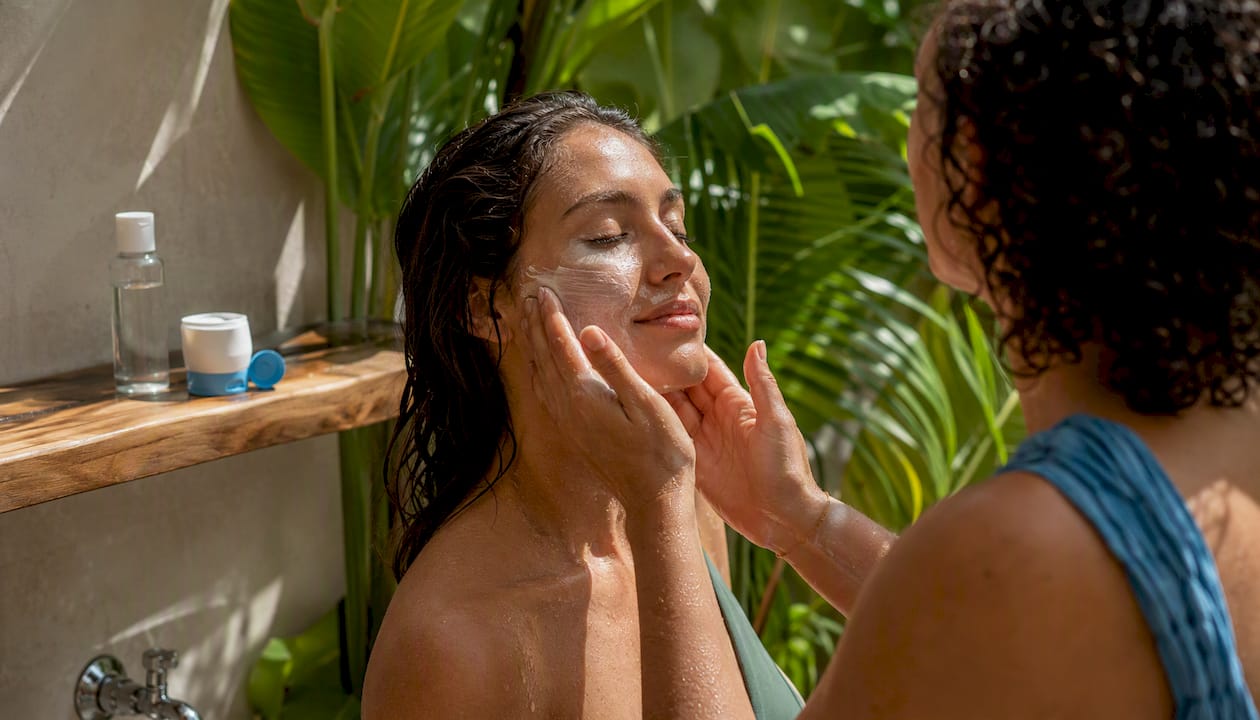
For extended outdoor time, keep a travel-size sunscreen in your bag and reapply over makeup using a powder SPF or a spray formula held at arm’s length.
Key Takeaways
Broad-spectrum SPF 30+ sunscreen, applied as 1 ounce to the body 15 minutes before exposure and reapplied every 2 hours, is the foundation of effective UV protection when combined with shade, clothing, and UV400 sunglasses.
| Point | Details |
|---|---|
| SPF 30+ broad-spectrum | Choose water-resistant, broad-spectrum SPF 30 or higher for reliable UVA and UVB coverage. |
| Apply 1 oz, 15 min before | Use about 1 ounce for the body and apply 15 minutes before going outside to activate protection. |
| Reapply sunscreen regularly, especially after swimming, sweating, or toweling off | Reapply after swimming, sweating, or toweling off; no sunscreen lasts all day on one application. |
| Layer shade and clothing | Combine sunscreen with shade, UPF clothing, wide-brim hats, and UV400 sunglasses for full coverage. |
| Cosmedica-skincare daily routine | Cosmedica-skincare’s serums and moisturizers are formulated to layer under sunscreen for a complete morning routine. |
The sun protection habit most people skip
Most sun protection advice focuses on what to buy. What actually matters more is consistency. A SPF 50 sunscreen applied once at 8 a.m. and never touched again offers less real-world protection than an SPF 30 reapplied properly throughout the day.
We also tend to underestimate the cumulative effect of “incidental” exposure: the walk to the car, the lunch outside, the drive home through a sunny window. UVA rays penetrate glass, which means your morning commute counts. Building reapplication into your routine, the same way you build in drinking water, is what separates people who age well from people who are surprised by it later.
The checklist in this article is not complicated. It is just consistent.
Cosmedica-skincare’s approach to sun-ready skin
Protecting your skin from UV is only half the equation. The other half is keeping your skin barrier strong, hydrated, and supported with the right actives so sunscreen can do its job properly. Cosmedica-skincare’s cruelty-free, dermatologist-tested formulations are built for exactly that: serums, moisturizers, and targeted treatments that prep your skin in the morning and repair it at night.
If you’re building a sun-protection-first routine, the Super Serum Set is a practical starting point. It pairs antioxidant and hydration actives that work under your SPF, not against it. Browse the full moisturizer collection to find a lightweight daily option that layers cleanly with sunscreen.
Authoritative sources and further reading
These U.S. government and medical organizations publish the primary guidance this article draws from:
- CDC Skin Cancer Sun Safety: UV index guidance, peak-hour data, and reflective-surface risk
- FDA Sunscreen Consumer Update: Label rules, water-resistance claims, and sunglasses standards
- EPA Sun Safety Tips: UV Index explanations and daily protection recommendations.
FAQ
What SPF should you use for daily sun protection?
The American Academy of Dermatology recommends broad-spectrum SPF 30 or higher for daily use. SPF 30 blocks about 97% of UVB rays when applied correctly.
How much sunscreen do you actually need to apply?
Use about 1 ounce (roughly a shot glass) for your body and 1 teaspoon for your face. Applying less than that reduces protection significantly below the labeled SPF.
Do you need sunscreen on cloudy days?
Yes. Up to 80% of UV rays penetrate cloud cover, so cloudy days still carry meaningful UV exposure risk.
What sunglasses actually protect your eyes from UV?
Look for sunglasses labeled UV400 or 100% UV protection, which blocks more than 99% of UVA and UVB. Lens color and price do not indicate UV protection level.
When should you reapply sunscreen?
Reapply sunscreen regularly, especially after swimming, sweating, or toweling off, and immediately after swimming, heavy sweating, or toweling off, regardless of the water-resistance rating on the label.