

Natural Moisturizing Factors: What They Are and Why They Matter
Natural moisturizing factors (NMFs) are a collection of water-soluble, low-molecular-weight compounds found inside the outermost skin cells that act like tiny sponges, pulling moisture from the air and holding it within the skin. They live in the stratum corneum (SC), the skin’s outermost layer, and they are the reason healthy skin stays soft and flexible even in dry conditions. According to NCBI Bookshelf, these osmotically active molecules can absorb atmospheric water at relative humidities down to about 50%.
Here’s what you need to know right away:
- NMFs are mostly derived from a protein called filaggrin, which breaks down into free amino acids and their derivatives.
- When NMF levels drop, skin becomes tight, flaky, and prone to cracking — and the barrier weakens enough to let irritants in.
- Conditions like atopic dermatitis and ichthyosis vulgaris are directly linked to low NMF from filaggrin gene mutations.
- The good news: moisturizers formulated with glycerin, urea, and lactic acid can help restore NMF levels.
If your skin is persistently cracked, severely dry across large areas, or you suspect a genetic skin condition, a board-certified dermatologist is the right next step.
Key Takeaways
Natural moisturizing factors are the skin’s internal hydration system, and supporting them with the right ingredients and gentle routines is more effective than relying on heavy creams alone.
| Point | Details |
|---|---|
| NMFs are inside skin cells | Water-soluble compounds in corneocytes bind atmospheric moisture down to about 50% relative humidity. |
| Filaggrin is the main source | Caspase-14, bleomycin hydrolase, and calpain-1 convert filaggrin into free amino acids and NMF derivatives. |
| Low NMF links to real conditions | FLG mutations reduce NMF and are directly associated with ichthyosis vulgaris and atopic dermatitis. |
| Moisturizers can restore NMF | Formulations with glycerin, urea, and lactic acid measurably raise SC NMF levels with regular use. |
| Apply humectants on damp skin | Always follow with an occlusive to prevent reverse osmotic water loss in dry environments. |
Table of Contents
- What are moisturizing factors and where do they live in your skin?
- What are NMFs actually made of?
- How does your skin produce NMFs?
- What do NMFs actually do for your skin?
- Why do NMF levels drop, and when does it become a medical concern?
- How can you support your skin’s NMF levels every day?
- How do researchers measure NMF, and what does the evidence show?
- Expert notes for choosing products that support NMF
- Why understanding NMFs changes how you think about skincare
- Sources
- FAQ
What are moisturizing factors and where do they live in your skin?
Think of your skin as a layered structure. The deepest layer, the epidermis, produces new cells that gradually migrate upward. By the time they reach the surface, those cells have flattened into tough, protein-packed structures called corneocytes. These corneocytes stack together in the stratum corneum, held in place by a lipid “mortar” of ceramides, fatty acids, and cholesterol.
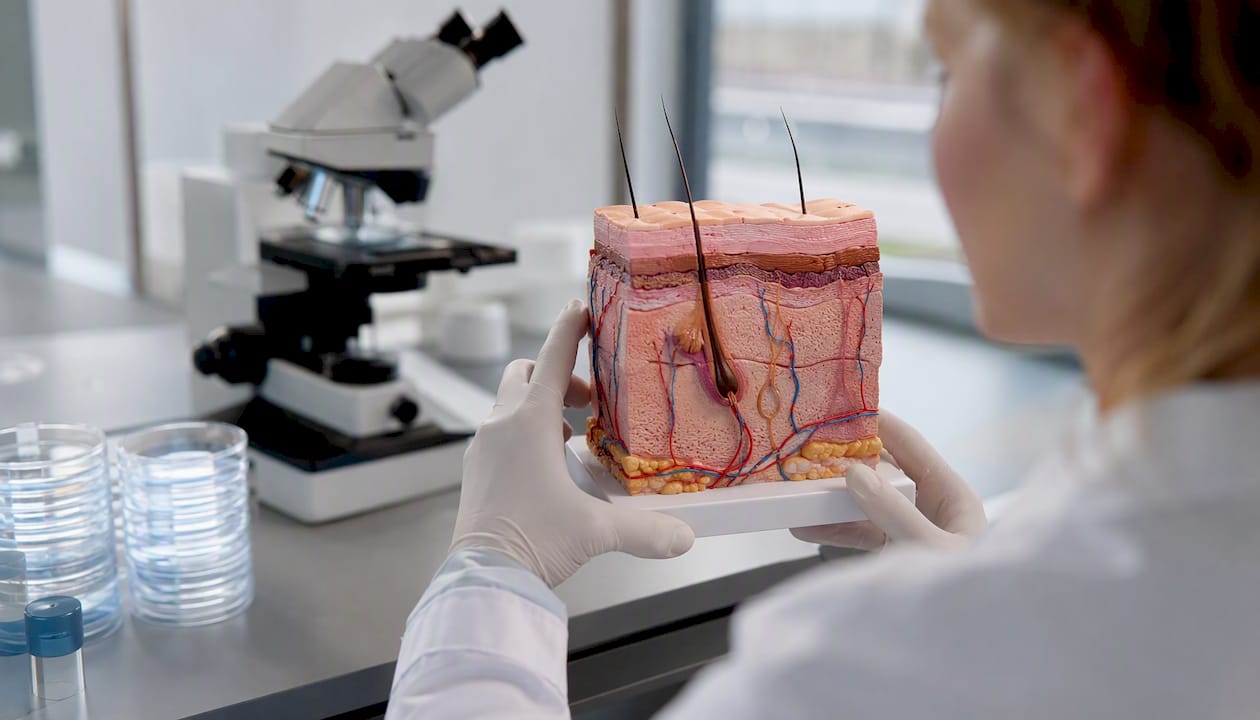
NMFs live inside those corneocytes. They are intracytoplasmic — meaning they are packaged within the cell itself, not floating in the lipid matrix between cells. That location is critical. Because they are water-soluble and hygroscopic (they attract water), they keep the interior of each corneocyte hydrated. That internal hydration is what gives skin its elasticity and pliability. Without it, corneocytes become rigid and brittle, and the SC loses its ability to flex without cracking.
That concentration matters because it determines how much water the SC can hold under varying environmental conditions, from humid summers to dry, heated indoor air in winter.
What are NMFs actually made of?
NMFs are not a single molecule. They are a mixture of several chemical classes, each contributing to hydration in slightly different ways. Practical Dermatology’s clinical review identifies the main groups as amino acids and their derivatives, urea, lactic acid, inorganic salts, and sugars.
Filaggrin-derived components make up the majority:
- Free amino acids (serine, glycine, alanine, and others) — direct breakdown products of filaggrin
- Pyrrolidone carboxylic acid (PCA) — formed from glutamine/glutamic acid; one of the most hygroscopic NMF components
- Urocanic acid (UCA) — derived from histidine; also plays a role in UV absorption and pH modulation
- Trans-urocanic acid — the predominant form in the SC under normal conditions
Non-filaggrin components round out the mix:
- Urea — softens the SC and enhances water uptake
- Lactic acid — a humectant and mild exfoliant that also influences SC pH
- Inorganic salts (sodium, potassium, calcium, chloride) — contribute to osmotic water-binding
- Sugars (glucose, fructose, glucosamine) — minor hygroscopic contributors
Biophysical research published in the Journal of Physical Chemistry B adds a layer to this picture: molecules like urea, glycerol, and UCA also influence lipid membrane mobility and fluidity in the SC. That means NMFs do more than bind water — they help maintain the structural flexibility of the entire cornified layer.
| NMF Component Class | Key Molecules | Primary Source |
|---|---|---|
| Free amino acids | Serine, glycine, alanine | Filaggrin proteolysis |
| PCA and UCA | Pyrrolidone carboxylic acid, urocanic acid | Filaggrin-derived amino acids |
| Urea | Urea | Non-filaggrin metabolic pathways |
| Organic acids | Lactic acid | Sweat, glycolysis |
| Inorganic salts | Sodium, potassium, chloride | Transepidermal diffusion |
| Sugars | Glucose, fructose | Metabolic origin |
How does your skin produce NMFs?
The production pathway is elegant and tightly regulated. It starts deep in the epidermis and ends with a cascade of enzymatic reactions in the upper SC.
- Profilaggrin synthesis: Keratinocytes in the granular layer produce profilaggrin, a massive phosphorylated protein stored in dense keratohyalin granules.
- Dephosphorylation and cleavage: As cells transition into corneocytes, profilaggrin is dephosphorylated and cleaved into individual filaggrin monomers by serine proteases.
- Deimination: Filaggrin monomers are deiminated (arginine residues converted to citrulline) by peptidylarginine deiminases, making them more susceptible to further breakdown.
- Proteolysis into NMF: Three enzymes drive the final conversion of filaggrin into free amino acids and NMF derivatives: caspase-14, bleomycin hydrolase (BH), and calpain-1.
Research published in the Journal of Investigative Dermatology shows that caspase-14 deficiency specifically reduces UCA and PCA levels, confirming its role as a key protease in NMF generation. Bleomycin hydrolase has been characterized as another NMF-generating enzyme, and research from JSTAGE shows that BH activity declines with age and in atopic skin, which helps explain why older adults and people with eczema tend to have lower NMF.
This feedback system also means that FLG loss-of-function mutations — which reduce filaggrin production from the start — cut off the supply of NMF at the source, with downstream consequences for barrier function and disease risk.
What do NMFs actually do for your skin?
The functions of NMFs go well beyond simple moisturization. Here’s what they’re doing every day:
- Water retention: NMFs are hygroscopic, drawing water from the environment and holding it within corneocytes. This keeps the SC pliable and prevents the micro-cracking that leads to visible flaking.
- SC elasticity and plasticity: Hydrated corneocytes flex without breaking. Low NMF means rigid cells that crack under normal facial movement.
- Desquamation support: The enzymes responsible for shedding dead skin cells (serine proteases like kallikreins) require a specific water activity and pH to function. NMFs maintain both, keeping cell turnover smooth and regular.
- pH modulation: Lactic acid and UCA contribute to the SC’s slightly acidic surface pH (around 4.5–5.5). This “acid mantle” inhibits pathogenic bacteria and supports the activity of barrier-repair enzymes.
- Possible antimicrobial and UV roles: UCA absorbs UV radiation and has been studied for its role in immune modulation. Some NMF amino acids may also contribute to the SC’s antimicrobial environment.
The PMC review on filaggrin-derived NMF confirms that NMF modulates SC pH, retains water, and may carry antimicrobial activity — connecting these molecular functions directly to clinical outcomes like atopic dermatitis risk. Understanding the difference between hydration and moisture helps clarify why NMFs sit at the center of both.
Why do NMF levels drop, and when does it become a medical concern?
Several factors can deplete NMFs, ranging from genetics to your daily routine.

Genetic causes: FLG loss-of-function mutations are the most well-characterized driver of low NMF. These mutations reduce filaggrin production, cutting off the primary source of amino acid-derived NMF components. The result is ichthyosis vulgaris (dry, scaly skin from birth or early childhood) and a significantly elevated risk of atopic dermatitis.
Aging: BH activity declines with age, and older skin produces less filaggrin overall. This contributes to the dry, thin skin texture common in adults over 50 — a pattern that responds differently to moisturizers than transient environmental dryness.
Environmental stress: Low humidity, cold air, and wind accelerate transepidermal water loss (TEWL) and can deplete NMF faster than the skin replenishes it. Heated indoor environments in winter are a particularly common trigger.
Barrier damage: Harsh surfactants, over-exfoliation, and prolonged water exposure strip the SC lipids and wash out water-soluble NMF components. Repeated damage without recovery time compounds the loss.
Inflammation: In atopic dermatitis, the inflammatory environment disrupts filaggrin processing and accelerates NMF depletion. This creates a cycle: low NMF weakens the barrier, allowing allergens to penetrate, which drives more inflammation, which further reduces NMF. Why skin loses moisture covers this cycle in practical detail.
Pro Tip: If your skin is chronically dry despite consistent moisturizing, the issue may be enzymatic rather than just environmental. A dermatologist can assess whether a prescription barrier-repair regimen or targeted therapy is appropriate.
See a dermatologist if you experience: persistent, widespread cracking; severe xerosis that does not respond to over-the-counter moisturizers; recurrent dermatitis or eczema; or dryness that began in childhood and affects large body areas (possible ichthyosis).
How can you support your skin’s NMF levels every day?
The goal is not to replace your skin’s NMF system but to support it. The right ingredients and routine habits make a real difference.
Ingredients that mimic or replenish NMF components:
- Glycerin — a powerful humectant that draws water into the SC, functionally similar to NMF’s hygroscopic action
- Urea (5–10%) — softens the SC, enhances water uptake, and at lower concentrations acts as a gentle humectant
- Lactic acid — both a humectant and a mild exfoliant that supports desquamation; Cosmedica-skincare’s 5% Lactic Acid Treatment + Hylasyn combines it with hyaluronic acid for layered hydration
- Amino acids (glycine, serine, PCA derivatives) — directly replenish filaggrin-derived NMF components
- Hyaluronic acid — a large-molecule humectant that holds water at the surface; pairs well with smaller NMF-mimicking molecules that penetrate deeper
Routine habits that protect NMF:
- Apply humectants to damp skin right after cleansing. Humectants pull water from the environment, and damp skin gives them a head start.
- Always follow a humectant with an occlusive or emollient (like a moisturizer or facial balm) to seal in the water you just attracted. Skipping this step can cause reverse osmotic loss — the humectant draws water out of the skin instead of in, especially in very dry air.
- Use a gentle, low-surfactant cleanser to avoid stripping water-soluble NMF components during washing.
- Limit exfoliation to 1–2 times per week to avoid over-removing the SC before it can replenish its NMF.
- In winter or low-humidity environments, consider a humidifier to keep ambient humidity above 50% — the threshold at which NMF can still absorb atmospheric water.
Pro Tip: Apply your humectant serum immediately after patting skin dry (while it’s still slightly damp), then layer a moisturizer on top within 60 seconds. This two-step “sandwich” is the most effective way to trap water in the SC.
For a full routine framework, the hydration workflow guide walks through layering order step by step. When over-the-counter options are not enough, a dermatologist may recommend prescription emollients or barrier-repair formulations for conditions like atopic dermatitis.
How do researchers measure NMF, and what does the evidence show?
Understanding NMF scientifically requires getting it out of the skin first. The standard approach is tape-stripping: sequential strips of adhesive tape are applied to the skin and removed, each one lifting a layer of corneocytes. The collected material is then analyzed by mass spectrometry.
Measurement methods:
- LC-MS (liquid chromatography-mass spectrometry): The gold standard for quantifying individual NMF components with high accuracy. Requires lab processing but delivers detailed molecular profiles.
- GC-MS (gas chromatography-mass spectrometry): Used for volatile or derivatized NMF components; less common in recent studies.
- DART-MS (direct analysis in real time-mass spectrometry): A newer, faster approach. Research published in Nature Scientific Reports demonstrated that DART-MS can quantify multiple NMF components from tape-stripped SC samples, with a reported throughput of approximately 100 strips measured in about 2 hours — making it practical for larger studies.
What the evidence shows:
- Regular use of appropriate moisturizers can measurably increase NMF levels in the SC. A study in the International Journal of Cosmetic Science found that moisturizer regimens raised NMF and helped restore the proFLG-FLG-NMF system, with some increases persisting after discontinuation.
- NMF levels vary by body site and age, with older skin showing lower free amino acid content — a finding consistent with the age-related decline in BH activity.
- Most human studies involve small cohorts, and some mechanistic findings come from animal models, so the evidence base is strong in direction but still growing in scale.
Limitations to keep in mind:
- Tape-stripping results vary by body site, season, and technique.
- DART-MS is promising but not yet universally standardized across labs.
- Long-term intervention studies in diverse populations are still limited.
Expert notes for choosing products that support NMF
When you’re scanning an ingredient list, here’s what to look for and what to keep in mind:
- Glycerin near the top of the list signals a meaningful humectant concentration; it’s the most studied NMF-mimicking ingredient in cosmetic formulations.
- Urea at 5–10% is the range used in clinical studies for xerosis and mild ichthyosis; concentrations below 2% are mostly cosmetic. Higher concentrations (above 20%) are typically prescription territory and used for keratotic conditions.
- Lactic acid at 5–12% is the clinically studied range for exfoliation and hydration; cosmetic products typically use 5–8% to balance efficacy with tolerability.
- Amino acid complexes (look for glycine, serine, proline, or “hydrolyzed protein” derivatives) directly supplement the filaggrin-derived fraction of NMF.
- Avoid formulations with high concentrations of alcohol denat. or sodium lauryl sulfate (SLS) as primary ingredients — both strip water-soluble NMF components.
For guidance on pairing these ingredient types effectively, the best skincare ingredient combinations resource covers layering logic in practical terms.
Why understanding NMFs changes how you think about skincare
We tend to reach for heavier creams when our skin feels dry, as if the answer is always more product. But the real story is more interesting than that. Your skin has its own built-in hydration system — one that evolved to keep corneocytes pliable across wildly different climates. When that system is working, even a lightweight moisturizer does its job well. When it’s not, no amount of thick cream fully compensates for depleted NMF.
What actually changes behavior is understanding that the goal is to support the filaggrin-to-NMF pathway, not just coat the surface. That means choosing gentler cleansers, applying humectants on damp skin, and giving the SC time to recover between exfoliation sessions. Prevention is genuinely more effective than rescue. A skin barrier that never gets stripped in the first place retains its NMF far better than one that’s constantly being repaired.
The Cosmedica-skincare Super Serum Set is a practical starting point for building a hydration-first routine that works with your skin’s own system rather than around it.
Sources
- Moisturizers (NCBI Bookshelf)
- Early-life regional and temporal variation in filaggrin‑derived natural moisturizing factor (PMC)
- Profilaggrin, filaggrin and natural moisturizing factor (PubMed)
- Understanding the Role of Natural Moisturizing Factor in Skin Hydration (Practical Dermatology)
This article is general information, not a substitute for advice from a qualified doctor. Consult a qualified healthcare professional about your own circumstances before acting on anything here.
FAQ
What are natural moisturizing factors in simple terms?
Natural moisturizing factors are a group of water-attracting compounds found inside the outermost skin cells that keep skin hydrated, flexible, and healthy. They are mostly produced when the skin protein filaggrin breaks down into amino acids and their derivatives.
How can you increase NMF levels in your skin?
Applying humectants to damp skin and sealing with an occlusive gives the best results.
What hydrates skin most effectively from the inside?
NMFs are the skin’s primary internal hydration mechanism, drawing water from the environment and holding it within corneocytes. Supporting filaggrin production through gentle routines and barrier-friendly ingredients keeps this system working at its best.
What should you look for in a moisturizer to support NMF?
Look for formulations that combine a humectant (glycerin, urea, lactic acid, or amino acids) with an emollient and an occlusive.