

What Is Advanced Anti-Aging? Your Skin Science Guide
TL;DR:
- Advanced anti-aging involves using scientifically supported ingredients to prevent and repair visible skin aging. It emphasizes early sun protection and active ingredients like retinoids and vitamin C for long-term results.
What does “advanced anti-aging” actually mean for your skin?
Advanced anti-aging is the purposeful use of scientifically supported ingredients and practices to prevent, slow, and repair visible signs of skin aging. Think of it less as a product category and more as a strategy: one that targets the real biological causes of wrinkles, uneven pigmentation, and lost elasticity rather than just masking them.
Here’s what that strategy actually covers:
- Minimizing wrinkles and fine lines through collagen stimulation and cell turnover
- Improving skin elasticity by supporting the extracellular matrix with peptides and retinoids
- Evening skin tone with antioxidants and brightening actives like vitamin C
- Protecting against future damage with daily broad-spectrum sunscreen
- Repairing existing photoaging with proven topical agents
The key distinction? Advanced anti-aging blends prevention and treatment. You don’t have to wait for deep wrinkles to start. Starting early with sun protection and active ingredients in your 20s or 30s produces better long-term results than trying to reverse damage later.
Table of Contents
- Which ingredients actually have clinical proof behind them?
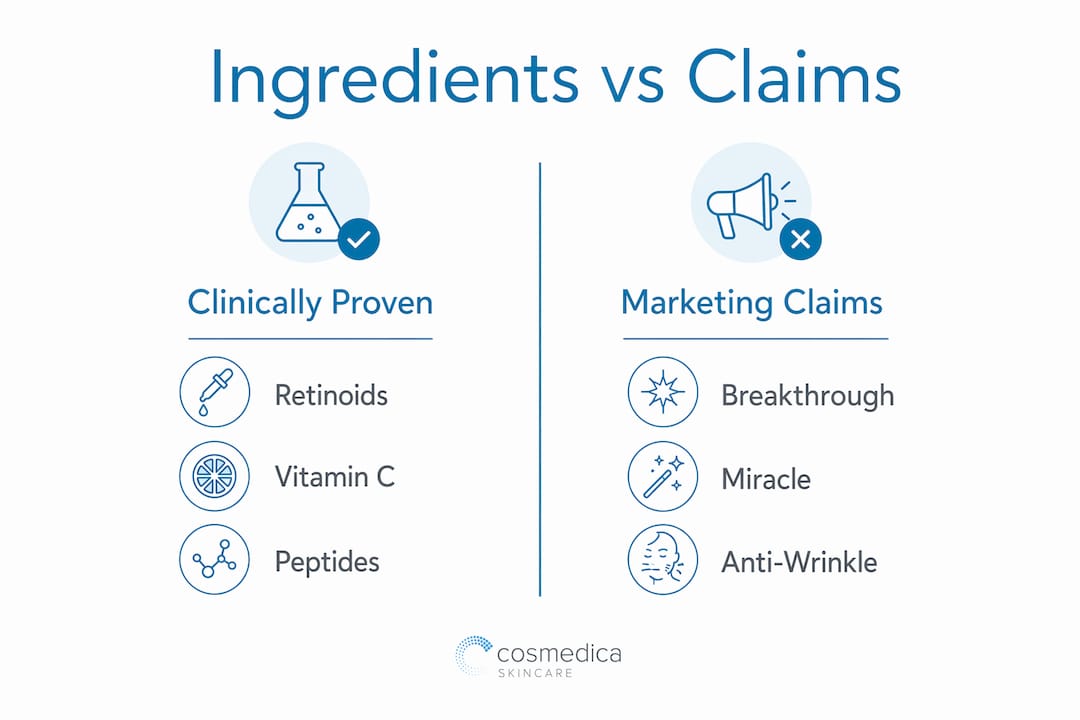
- Marketing claims vs. what the science actually says
- How to build an effective anti-aging routine without overcomplicating it
- How Cosmedica-skincare makes evidence-based anti-aging affordable
- Professional anti-aging treatments that go beyond skincare
- How to evaluate product quality so you don’t waste money
- Cosmedica-skincare: real ingredients, real results, real price
- FAQ
- Key Takeaways
Which ingredients actually have clinical proof behind them?
Not every ingredient earns its place on the label. A systematic review of cosmeceuticals covering 32 clinical studies found that retinol and vitamin C received a Grade A recommendation for anti-aging, while many other popular actives landed at Grade C or inconclusive.
Statistic to know: Broad-spectrum SPF 30+ sunscreen is highly effective at preventing visible photoaging. Nothing else in your routine comes close.
Here’s how the evidence stacks up for the core ingredients:
- Sunscreen (SPF 30+): The single most effective anti-aging product available. Daily use dramatically reduces UV-driven collagen breakdown and pigmentation.
- Retinoids: The most clinically substantiated topical agents for stimulating collagen synthesis and accelerating cell turnover. Expect 8–12 weeks of consistent use before visible improvement. Next-generation options like hydroxypinacolone retinoate offer comparable efficacy to tretinoin with better tolerance for sensitive skin.
- Vitamin C: A potent antioxidant and collagen co-factor. Topical vitamin C shows visible skin improvements within 4–8 weeks and earned a Grade A recommendation alongside retinol.
- Niacinamide: A form of vitamin B-3 with dermatologist consensus support for reducing fine lines, redness, and dark spots while strengthening the skin barrier.
- Peptides: Multifunctional support for the extracellular matrix and wrinkle reduction, though clinical effects tend to be modest and long-term data is still building.
Pro Tip: Apply vitamin C in the morning for antioxidant protection and your retinoid at night for repair. This two-phase approach targets the main aging mechanisms at the right times.
Marketing claims vs. what the science actually says
Here’s something worth knowing before you spend a dollar: “advanced” is usually a marketing word, not a scientific designation.
- “Clinically proven” rarely means what you think. Most consumer skincare claims rest on limited subjective testing, not rigorous FDA-approved clinical trials.
- Cosmeceuticals occupy a regulatory gray zone. The FDA classifies wrinkle creams as cosmetics, not drugs, meaning they don’t require pre-market safety or efficacy approval. The term “cosmeceutical” has no legal standing.
- Complex ingredient lists don’t equal better results. Many products combine proven actives with newer, less-tested ingredients to create an impression of sophistication without added clinical benefit.
- Skin type matters more than trends. A retinoid that works beautifully on one person can cause significant irritation on another. Individual needs, not marketing buzz, should drive your choices.
- Price doesn’t predict potency. Ingredient concentration and formulation stability matter far more than the cost of the jar.
The smarter move: look for products built around ingredients with strong evidence, and treat anything labeled “breakthrough” or “revolutionary” with healthy skepticism.
How to build an effective anti-aging routine without overcomplicating it
A good anti-aging regimen doesn’t need to be expensive or elaborate. Here’s a practical framework:
- Morning: Cleanser, vitamin C serum, moisturizer with niacinamide or ceramides, broad-spectrum SPF 30+
- Evening: Cleanser, retinoid (start 2–3 nights per week), moisturizer
- Weekly: Gentle chemical exfoliant like lactic acid to support cell turnover
A few things that make or break results:
- Introduce products one at a time. Adding multiple new actives simultaneously is one of the most common mistakes. Stagger introductions so you can identify what’s working and what’s irritating.
- Set realistic expectations. Visible results from retinoids require 8–12 weeks of consistent use. Vitamin C improvements show up in 4–8 weeks. Patience is part of the routine.
- Lifestyle factors compound your results. Quality sleep supports skin repair. A diet rich in antioxidants reduces systemic inflammation. Chronic stress accelerates collagen breakdown, so managing it is genuinely part of your anti-aging approach.
Pro Tip: Patch test every new product on your inner arm for 48 hours before applying it to your face. It takes two minutes and saves you from a week of irritation.
How Cosmedica-skincare makes evidence-based anti-aging affordable
Cosmedica-skincare builds its formulations around the ingredients the science actually supports: retinol, vitamin C, niacinamide, peptides, and ceramides. Every product is cruelty-free and dermatologist-tested, designed to work across diverse skin types without requiring a dermatologist’s budget.
- Retinol and vitamin C serums aligned with Grade A evidence-based actives
- Niacinamide treatments targeting barrier function, pigmentation, and fine lines
- Moisturizers with ceramides to lock in hydration and support the lipid barrier
- Targeted eye treatments addressing the thin, aging-prone skin around the eyes
Cosmedica-skincare’s approach is straightforward: give you the ingredients that work, skip the filler, and keep the price accessible so you can actually stay consistent. Consistency is what produces results.
Pro Tip: The Super Serum Set combines vitamin C, retinol, and peptides in one curated kit, which makes it easy to start the two-phase morning/night routine without hunting for each product separately.
Professional anti-aging treatments that go beyond skincare
Topical products do a lot, but some concerns respond better to in-office procedures. Here’s what’s worth knowing:
- Laser therapy targets pigmented cells and stimulates collagen. It typically requires multiple sessions and should be approached cautiously for darker skin tones due to hyperpigmentation risk.
- Chemical peels use alpha-hydroxy acids, glycolic acid, or trichloroacetic acid to remove the top skin layer, reducing age spots and improving texture. Depth and acid type vary by concern.
- Microneedling creates controlled micro-injuries that trigger collagen production, smoothing wrinkles and improving skin density over time.
- Neuromodulators (Botox) temporarily relax facial muscles to reduce expression lines. Effects last roughly 3–6 months.
- Soft tissue fillers restore volume and smooth deeper wrinkles. Results are immediate and can last 6 months to 2 years depending on the filler type.
These procedures complement a strong at-home routine rather than replace it. A dermatologist can help you decide which combination fits your skin type, concerns, and timeline.
How to evaluate product quality so you don’t waste money
Knowing how to select anti-aging products that actually work comes down to a few non-negotiable checks:
- Check ingredient concentration. Over-the-counter products often contain lower concentrations of actives than prescription versions. Look for retinol at 0.1%–1% and vitamin C (L-ascorbic acid) at 10%–20% for meaningful results.
- Look for formulation stability. Vitamin C degrades quickly in light and air. Choose opaque or airless packaging.
- Verify the evidence tier. Retinol and vitamin C have Grade A evidence. Ingredients without published clinical trials deserve more skepticism regardless of how they’re marketed.
- Read the FDA’s guidance on cosmetic claims. If a product claims to “rebuild collagen” or “restructure skin,” it’s making a drug claim without drug approval.
- Avoid fragrance in active formulations. Fragrance is a common irritant that can undermine the tolerance you’re building with retinoids.
Cosmedica-skincare: real ingredients, real results, real price
Spending less shouldn’t mean settling for less effective. Cosmedica-skincare’s new collection brings together the actives with the strongest clinical backing: retinol, vitamin C, niacinamide, and peptides, all in stable, dermatologist-tested formulations. No filler ingredients, no inflated price tags. Whether you’re building your first anti-aging routine or refining one that’s already working, Cosmedica-skincare gives you a clear, affordable path forward. Browse the latest formulations and find the right fit for your skin type and goals.
FAQ
What is advanced anti-aging in skincare?
Advanced anti-aging refers to the evidence-based use of proven ingredients and practices, such as retinoids, vitamin C, and daily SPF, to prevent and repair visible signs of skin aging like wrinkles, pigmentation, and lost elasticity.
How long does it take to see anti-aging results?
Retinoids generally require 8–12 weeks of consistent use before visible improvement, while topical vitamin C may show effects in 4–8 weeks.
Is “clinically proven” on a skincare label reliable?
Not always. Most consumer skincare claims are based on limited subjective testing rather than rigorous, independent clinical trials, and cosmetics are not required to obtain FDA approval before going to market.
When should you start an anti-aging routine?
Starting in your 20s or 30s with sun protection, hydration, and active ingredients produces better long-term results than attempting to reverse deep damage later.
What makes Cosmedica-skincare a good choice for anti-aging?
Cosmedica-skincare formulates around Grade A evidence-backed actives, retinol and vitamin C, in cruelty-free, dermatologist-tested products priced to make consistent use realistic for most budgets.
Key Takeaways
Advanced anti-aging works best when it combines daily sun protection, proven actives like retinoids and vitamin C, and realistic expectations of 8–12 weeks for visible results.
| Point | Details |
|---|---|
| Sunscreen is the foundation | Broad-spectrum SPF 30+ prevents up to 80% of visible photoaging, making it the most effective anti-aging product available. |
| Retinoids and vitamin C lead the evidence | Both earned a Grade A recommendation in a systematic review of cosmeceuticals, requiring consistent use over 8–12 weeks and 4–8 weeks respectively. |
| “Advanced” is often a marketing label | Many products combine proven actives with less-tested ingredients; prioritize formulations with strong clinical evidence over complex ingredient lists. |
| Introduce products gradually | Adding multiple new actives at once is a common mistake; patch test and phase in one product at a time to avoid irritation. |
| Cosmedica-skincare | Offers dermatologist-tested, cruelty-free formulations built around retinol, vitamin C, niacinamide, and peptides at accessible price points. |