

What Is Transepidermal Water Loss and How Do You Stop It?
Transepidermal water loss (TEWL) is the natural, ongoing evaporation of water through your skin’s outer layer into the air around you. It’s not inherently bad, but when it runs too high, your skin gets dry, tight, and irritated faster than it can repair itself. The single best fix is boring but true: apply a cream or ointment with humectants and occlusives right after you shower, twice a day, without skipping.
TL;DR:
- Applying a moisturizer immediately after showering, while skin is still damp, helps trap water and significantly reduces excess TEWL.
- Humidifiers can support skin hydration during dry months or in arid environments by counteracting low ambient humidity.
- Using creams or ointments with ceramides, petrolatum, or dimethicone is more effective in sealing moisture than lotions, which contain less lipid content.
- Elevated TEWL linked to pollution and seasonal changes requires environmental management and consistent barrier support for optimal skin health.
- If dryness persists despite proper moisturizing, a dermatologist should evaluate for underlying conditions or infections beyond simple barrier repair.
Table of Contents
- What Transepidermal Water Loss Actually Is
- Why Elevated TEWL Matters for Your Skin’s Health
- What Causes High TEWL: Environmental and Behavioral Triggers
- How TEWL Is Measured, and Why One Reading Isn’t the Whole Story
- Evidence-Backed Ways to Reduce Transepidermal Water Retention
- A Two-Minute Routine That Actually Lowers TEWL
- When Dry Skin Needs a Dermatologist, Not Just More Cream
- What the Research Really Tells Us About Water Loss
- The Mistake Almost Everyone Makes With Moisturizer
- Building Your Barrier-Support Routine With Cosmedica
- Sources
- FAQ
What Transepidermal Water Loss Actually Is
Your skin is leaking water right now, and that’s completely normal. TEWL describes the passive movement of water from the deeper layers of your skin, through the epidermis, and out into the surrounding air, driven by nothing more complicated than a humidity gradient. Think of your skin like a slightly damp sponge sitting in a dry room. Water naturally wicks toward the drier air. The stratum corneum, that thin, dead-cell outer layer of your epidermis, is what controls how fast that happens.
In healthy skin, this evaporation isn’t a leak to panic over. Normal TEWL rates run roughly 2.3 to 44 g/m²·h, and across your whole body, that adds up to about 300 to 400 mL of water lost per day through the skin alone. That’s basically a large glass of water evaporating off you daily without you noticing a thing. Rates above that range, especially anything climbing past 50 to 100 g/m²·h, usually signal a compromised barrier, whether from injury, severe dryness, or inflammatory skin disease.
A few things make this number move around more than people expect:
- Anatomic site matters. Your palms and soles lose water at different rates than your cheeks or forearms because skin thickness and gland density vary by location.
- Age changes the baseline. Older skin tends to hold moisture less efficiently as lipid production slows.
- Time of day and season shift readings. Even hydration status and recent activity can nudge the number.
Here’s the part most explainers skip: your skin doesn’t just sit there losing water passively. It fights back almost immediately. When TEWL ticks up even modestly, structures called lamellar bodies in the upper epidermis release stored lipids within minutes to patch the barrier. If the water loss continues, your skin ramps up longer-term repairs, boosting lipid production and increasing filaggrin, a protein that breaks down into natural moisturizing factor (NMF), a mix of amino acids and humectant compounds that pull water back into the stratum corneum. It’s a genuinely elegant defense system, and it’s also exactly why the right moisturizer can support something your skin is already trying to do on its own.
Why Elevated TEWL Matters for Your Skin’s Health
A little water loss is background noise. Too much, sustained for too long, is where real problems start.
The most immediate consequence is xerosis, the clinical term for the flaky, tight, sometimes cracked dryness most of us just call “dry skin.” Once TEWL climbs past what your skin’s repair mechanisms can offset, you start seeing:
- Rough, flaky texture that doesn’t smooth out with a single application of lotion
- Increased sensitivity to products that never used to bother you
- Redness or a stinging sensation when you apply anything, even water
- Visible fine lines that look deeper simply because the skin has lost its plumpness
- A dull, uneven appearance that no amount of highlighter fixes
There’s a deeper clinical story here, too. Dermatologists use TEWL as an objective, measurable marker of barrier function, not just a cosmetic complaint. In conditions like atopic dermatitis and psoriasis, elevated TEWL tends to track closely with flare severity. A compromised barrier lets irritants, allergens, and microbes penetrate more easily, which triggers inflammation, which further damages the barrier, which raises TEWL again. It’s a feedback loop, and breaking it usually means addressing the water loss directly rather than only treating the inflammation after the fact.
This is also why “just moisturize more” isn’t fluffy advice when a dermatologist says it. It’s a targeted intervention aimed at interrupting that cycle before it escalates into something that needs a prescription.
Even outside diagnosed skin conditions, chronically elevated TEWL shows up cosmetically in ways that matter to how skin looks and feels day to day. Skin that’s constantly fighting to retain water has less structural resilience, which is part of why persistently dry, barrier-stressed skin tends to show fine lines and rough texture more prominently than well-hydrated skin of the same age. None of this requires a dramatic injury or diagnosis. It’s the cumulative effect of small, repeated barrier insults, which is exactly what the next section digs into.
What Causes High TEWL: Environmental and Behavioral Triggers
Some of what drives excess water loss is within your control. Some genuinely isn’t. Knowing the difference helps you stop blaming yourself for factors like age or climate while still fixing the habits that are fixable.
- Topical irritants and over-exfoliation. Harsh sulfate cleansers, high-frequency chemical exfoliation, and undiluted essential oils strip lipids faster than your skin can replace them. Retinoids and benzoyl peroxide, while effective for acne and aging concerns, are well-documented for temporarily raising TEWL during the adjustment period, which is why dermatologists recommend buffering them with a supportive moisturizer rather than stopping them outright.
- Hot showers and frequent washing. Water above roughly 100°F strips sebum efficiently, and washing your face or hands more than a few times daily compounds the damage. Long, hot showers feel good and do real harm to the lipid layer that’s supposed to be holding water in.
- Low humidity and seasonal shifts. Indoor heating in winter and dry climates year-round pull moisture out of skin faster than temperate, humid conditions do. A systematic review of environmental factors and TEWL found that climate and seasonal effects across studies were genuinely mixed, some showed the expected winter spike, others didn’t, which suggests individual skin type and local conditions matter more than a blanket seasonal rule.
- Air pollution. This is the finding that surprises most people. That same systematic review found that every study examining particulate matter and nitrogen dioxide exposure concluded that pollution exposure increased TEWL. If you live somewhere with heavy traffic pollution or wildfire smoke exposure, your skin may need more consistent barrier support than someone breathing cleaner air, independent of anything you’re doing wrong skincare-wise.
- Intrinsic and anatomic factors. Age reduces lipid synthesis over time. Genetic variation in filaggrin production (the same protein tied to NMF formation) affects baseline barrier strength, and it’s part of why some people seem to tolerate harsh products fine while others react to everything. Underlying conditions like eczema or psoriasis also predispose skin to higher baseline TEWL regardless of routine.
The practical takeaway isn’t to panic about pollution you can’t control. It’s to recognize that your environment is doing work against your barrier around the clock, which makes the moisturizing habits in the next few sections less optional than they might feel on a good skin day.
How TEWL Is Measured, and Why One Reading Isn’t the Whole Story
Dermatology researchers measure TEWL with an open-chamber probe, most commonly a device called a TEWAmeter, pressed gently against the skin for a short period while it tracks the humidity gradient rising off the surface. The output is reported in grams per square meter per hour (g/m²·h), the same unit used for the normal ranges mentioned earlier.
It sounds straightforward. It isn’t, entirely. A handful of variables can shift a reading enough to mislead you or a clinician if taken at face value:
- Probe and skin temperature. Warmer skin evaporates water faster, so a reading taken right after exercise or a hot shower will run higher than one taken on rested, room-temperature skin.
- Local microclimate. Air currents, room humidity, and even how close someone is standing to the measurement site can alter the gradient the probe detects.
- Anatomic site. Comparing a forehead reading to a forearm reading isn’t apples to apples, since baseline lipid content and skin thickness differ by location.
- Calibration drift. Devices need regular calibration, and even a well-calibrated probe measures a instant snapshot, not a stable trait.
This is why the same systematic review that flagged pollution as a consistent TEWL driver also emphasized controlled measurement conditions as essential to interpreting results across studies. A single number taken in a dermatology office on one afternoon tells you far less than a trend measured consistently over weeks. Clinicians who use TEWL data seriously look at change over time and cross-reference it with visible symptoms, not a single figure in isolation. If you ever see a TEWL number quoted online as if it were a diagnosis, treat it with the same skepticism you’d give a single bathroom scale reading after a big meal.
Evidence-Backed Ways to Reduce Transepidermal Water Retention
Here’s where the science turns into something you can actually do tonight. Reducing TEWL comes down to three ingredient categories working together, plus getting the timing and vehicle right, since even the best ingredient underperforms in the wrong formula.
Humectants pull water into the skin and hold it there. Glycerin and hyaluronic acid are the two most studied examples, acting almost like a sponge that grabs moisture from the air and from deeper skin layers and keeps it near the surface where it’s needed. Emollients work differently. They smooth rough, flaky texture by filling in the microscopic gaps between skin cells, improving how skin feels without necessarily sealing anything in. Occlusives are the sealant layer, physically slowing evaporation at the skin’s surface. Petrolatum and dimethicone are the two most reliable occlusive ingredients backed by decades of dermatologic use and research.
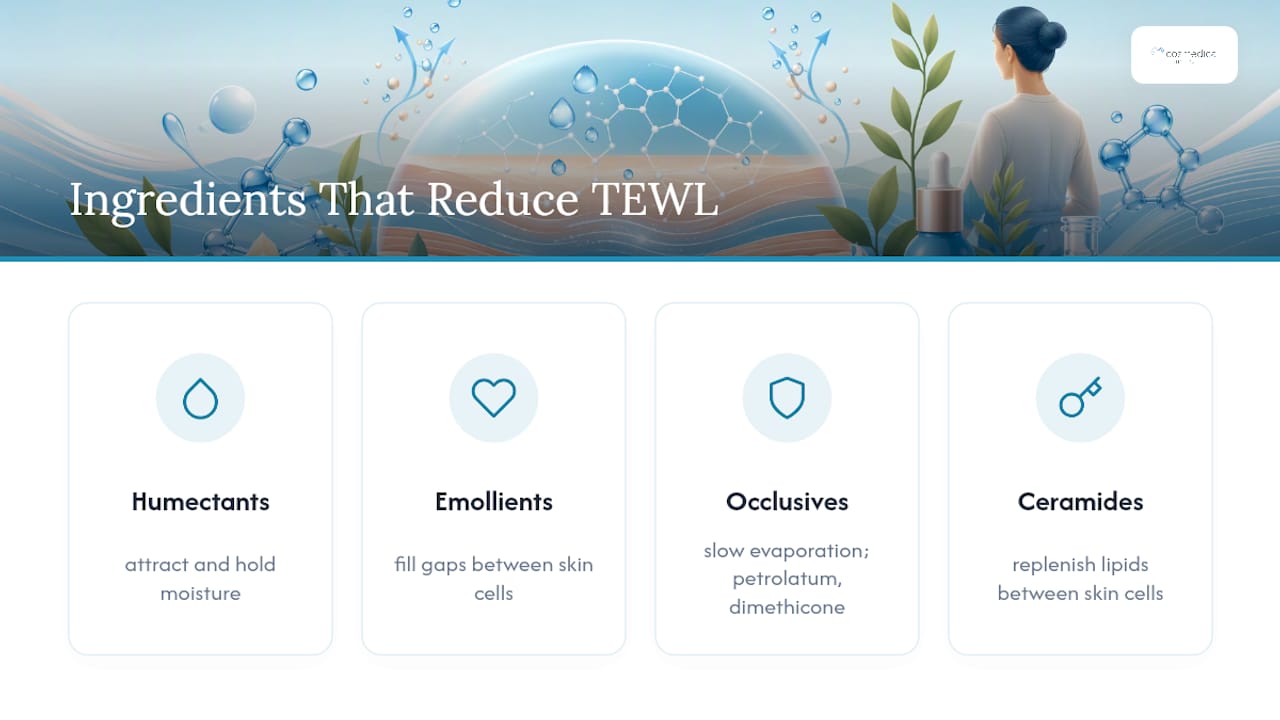
Ceramides deserve their own mention. They’re lipids that occur naturally in the stratum corneum, and topical ceramides essentially resupply the mortar between your skin cells rather than just sitting on top of them.
One detail changes outcomes more than most people realize: vehicle matters more than brand name. Clinical guidance consistently favors creams and ointments over lotions for meaningfully reducing TEWL, because lotions are mostly water with a lower concentration of the lipids that actually block evaporation. A $12 ceramide cream in a heavy base will often outperform a $60 lotion, not because of the price tag but because of what the formula is actually built from.
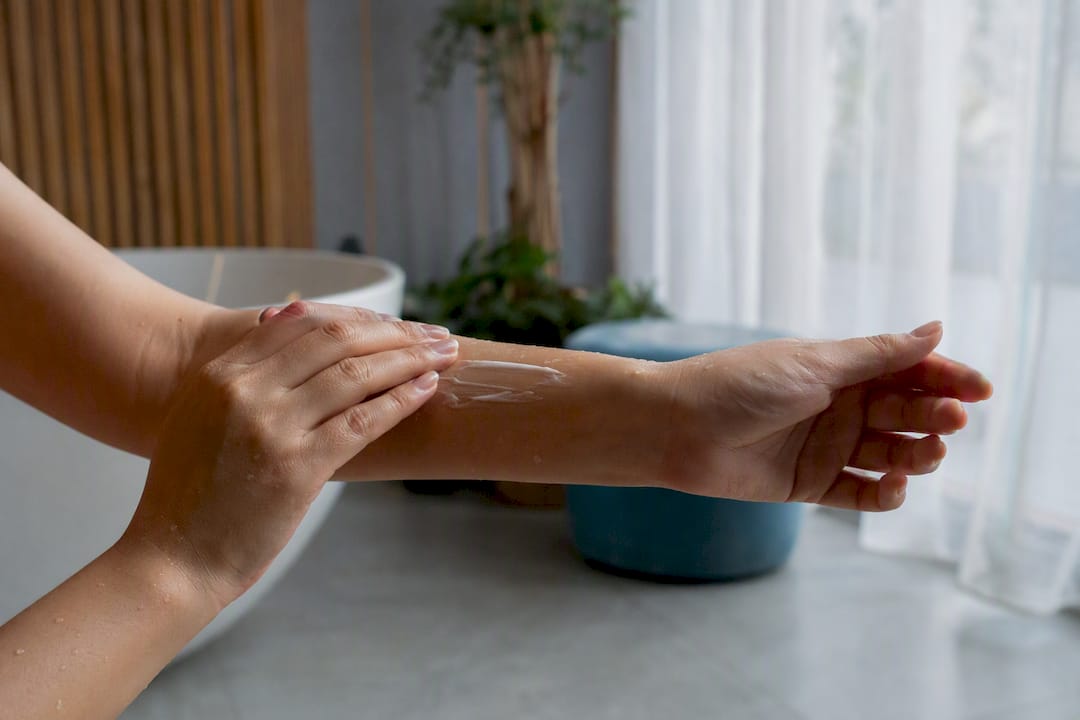
Timing counts almost as much as ingredient choice. Apply moisturizer within a few minutes of stepping out of the shower or bath, while skin is still slightly damp. That damp window helps trap water that would otherwise evaporate immediately, and it improves how well humectants can do their job. Clinical guidance generally recommends applying moisturizer at least twice daily, and for full-body application on adult skin, a practical benchmark is about 1 ounce (roughly 30 grams) per application, enough to leave a visible, even sheen without pilling.
For a deeper look at why some products underperform even when used consistently, this breakdown of common moisture-loss causes and fixes walks through the mismatch between ingredient and vehicle in more detail.
Pro Tip: Layer thinnest to thickest. Apply a hyaluronic acid or glycerin serum first while skin is damp, then follow with a ceramide cream to seal it in. Applying the heavy cream first actually blocks the humectant from absorbing properly.
There’s also a special case worth knowing about if you or someone you’re caring for deals with prolonged skin wetness, like incontinence-related moisture exposure. In those situations, breathable barrier creams built around dimethicone are specifically formulated to shed excess external moisture while still allowing the skin underneath to manage its own natural water balance, rather than trapping everything against the skin the way a fully occlusive ointment would.
Learn more about how emollients specifically function within this system in this ingredient-level explainer, which pairs well with the ceramide and occlusive information above.
A Two-Minute Routine That Actually Lowers TEWL
Consistency beats intensity here. A modest routine done daily outperforms an elaborate one done sporadically, and the steps below take less time than making coffee.
- Cleanse with lukewarm water, not hot. Skip anything above roughly 100°F, and use a gentle, sulfate-free cleanser rather than a foaming one that strips lipids along with dirt.
- Pat, don’t rub, when drying. Leave skin slightly damp instead of towel-drying to bone dry. That residual moisture is exactly what your humectant step will lock in.
- Apply a humectant serum within 2 to 3 minutes. Hyaluronic acid or glycerin-based formulas work best on damp skin, not dry skin, since they need water present to actually pull inward.
- Seal with a cream or ointment, not a lotion. This is the occlusive step, and it’s the one people skip most often when they’re in a hurry.
- Repeat morning and night, without exception on the night step. Skin does most of its repair work overnight, so this application matters more than the morning one if you’re only going to be consistent about one.
A few habit swaps make this routine work harder without adding steps. Run a humidifier in your bedroom during dry winter months or in consistently arid climates. It directly counters the low-humidity environmental trigger discussed earlier. Face, hands, and body all follow the same core logic, humectant then occlusive, but hands typically need reapplication several times a day since washing strips them repeatedly, and body moisturizer only needs the twice-daily rhythm unless you’re showering more than that.
If winter is your specific problem season, this seasonal routine guide goes deeper into adjusting product weight and frequency as humidity drops.
When Dry Skin Needs a Dermatologist, Not Just More Cream
Most elevated TEWL responds to consistent barrier care within a few weeks. Some situations call for professional evaluation instead of waiting it out.
Watch for these signals that barrier care alone isn’t enough:
- A rash that’s spreading, getting redder, or developing raised borders despite consistent moisturizing
- Signs of infection: warmth, pus, increasing pain, or fever alongside a skin lesion
- Cracking deep enough to bleed regularly, especially on hands or feet
- No improvement after two to three weeks of twice-daily moisturizing with an appropriate cream or ointment
- Sudden, widespread dryness with no clear cause, which can sometimes point to an underlying condition like thyroid dysfunction
A dermatologist evaluating stubborn dryness will typically start with a visual exam and history before reaching for any device, since TEWL readings taken in-office are one data point among several, not a standalone diagnosis. Expect questions about product history, washing habits, and any new medications, since several common prescriptions affect barrier function. If barrier support alone isn’t resolving things, clinicians often move to prescription-strength barrier repair formulas or address an underlying inflammatory condition directly, using TEWL improvement over follow-up visits as one marker that treatment is working.
What the Research Really Tells Us About Water Loss
The pollution finding deserves more attention than it usually gets. Every study in that systematic review examining PM and NO2 exposure found a consistent link to increased TEWL, while season and climate results were far less consistent. If you live in a high-traffic city or an area with regular wildfire smoke, your skin may be facing a barrier challenge that has nothing to do with your product choices and everything to do with your zip code.
At Cosmedica-skincare, our approach leans ingredient-first rather than marketing-first, prioritizing formulas built around the humectant, emollient, and occlusive categories the research actually supports, instead of chasing trend ingredients with thin evidence behind them.
A few final things worth knowing before you build your own routine:
- TEWL isn’t purely a problem to eliminate. Modest, low-level water loss is what triggers your skin’s own lamellar body lipid release, so the goal is managing excess loss, not suppressing the process entirely.
- More cream isn’t automatically better. Going past a comfortable, evenly absorbed layer wastes product without added barrier benefit.
- Avoid full occlusion tricks like sealing skin under plastic wrap for hours. It can trap moisture short-term, but it also blocks the signaling your skin uses to naturally regulate lipid production, which isn’t a tradeoff worth making for a temporary hydration boost.
Pro Tip: If your skin still feels tight 20 minutes after moisturizing, you likely applied too little, not the wrong product. Add a second thin layer rather than switching formulas entirely.
The Mistake Almost Everyone Makes With Moisturizer
The gap between what dermatology guidelines recommend and what people actually do is where most stubborn dryness lives. Clinical observation consistently shows people under-applying moisturizer or reaching for a thin lotion when a cream would do far more work, then concluding the product “doesn’t work” when the real issue was quantity and vehicle.
I think the fixation on finding the perfect ingredient distracts people from the far more boring truth: showing up twice a day with an adequate amount of a reasonably good cream will outperform an expensive serum applied once every few days. Skin barrier repair rewards consistency, not intensity.
A realistic, sustainable routine takes about two minutes, twice daily. That’s it. Not a ten-step regimen, not an expensive haul of serums. Damp skin, a humectant, a cream that actually contains occlusive ingredients, applied consistently for a few weeks before judging results. Most people quit right around the point their skin was about to turn a corner.
— Thomas
Building Your Barrier-Support Routine With Cosmedica
If you’re ready to put this into practice, Cosmedica-skincare builds its formulas around exactly the ingredient logic covered above, rather than around whatever’s trending that month. Our Super Serum Set covers the humectant layer with hyaluronic acid and other water-binding actives, meant to go on damp skin right after cleansing, before anything heavier. From there, our moisturizer collection includes ceramide-rich creams formulated to handle the emollient and occlusive steps in one product, so you’re not juggling five separate jars to get a complete routine.
If retinoid-related irritation has been pushing your TEWL up lately, our retinol guidance page walks through tolerance-building strategies that pair well with the barrier routine above. Start with the serum-then-cream layering method tonight, and give it two to three weeks before judging the results. Your skin’s repair mechanisms need that runway to catch up.
Sources
The pollution and TEWL connection referenced throughout this article comes from a systematic review of environmental exposure and water loss, the most rigorous look currently available at how air quality affects barrier function. For the physiology behind lamellar bodies, filaggrin, and the skin’s self-repair timeline, the clinical primer on skin barrier physiology breaks down mechanisms in more depth than most consumer content attempts. Practical application guidance, including vehicle choice and dosing amounts, draws from Medline’s clinical overview of TEWL prevention, written for care settings but directly applicable to daily home routines.
This article is general information, not a substitute for advice from a qualified doctor. Consult a qualified healthcare professional about your own circumstances before acting on anything here.
- Transepidermal water loss (TEWL): Environment and pollution—A systematic review
- PubMed: Article on TEWL normal ranges and physiology
- Medline: Transepidermal water loss: What it is and how to prevent it
- Fundamentals of skin barrier physiology (JCAD)
FAQ
What causes transepidermal water loss to increase?
Harsh cleansers, hot water, over-exfoliation, low humidity, and air pollution exposure (specifically particulate matter and NO2) all raise TEWL, alongside intrinsic factors like age and underlying skin conditions.
How do you fix elevated transepidermal water loss?
Apply a humectant like hyaluronic acid or glycerin to damp skin, then seal with a cream or ointment containing ceramides and occlusives such as petrolatum or dimethicone, done consistently twice daily.
Is transepidermal water loss a real medical measurement?
Yes, it’s measured with devices like a TEWAmeter and reported in g/m²·h, and dermatologists use it as an objective marker tracked alongside conditions like atopic dermatitis and psoriasis.
Can transepidermal water loss be fully prevented?
Not entirely, and it shouldn’t be. Some TEWL is a normal, healthy process that triggers your skin’s own repair signaling; the goal is reducing excess, pathological water loss rather than blocking evaporation completely.
How much moisturizer do you need to reduce TEWL effectively?
Clinical guidance suggests roughly 1 ounce (about 30 grams) for a full adult-body application, applied within minutes of bathing and repeated at least twice a day for meaningful barrier improvement.